
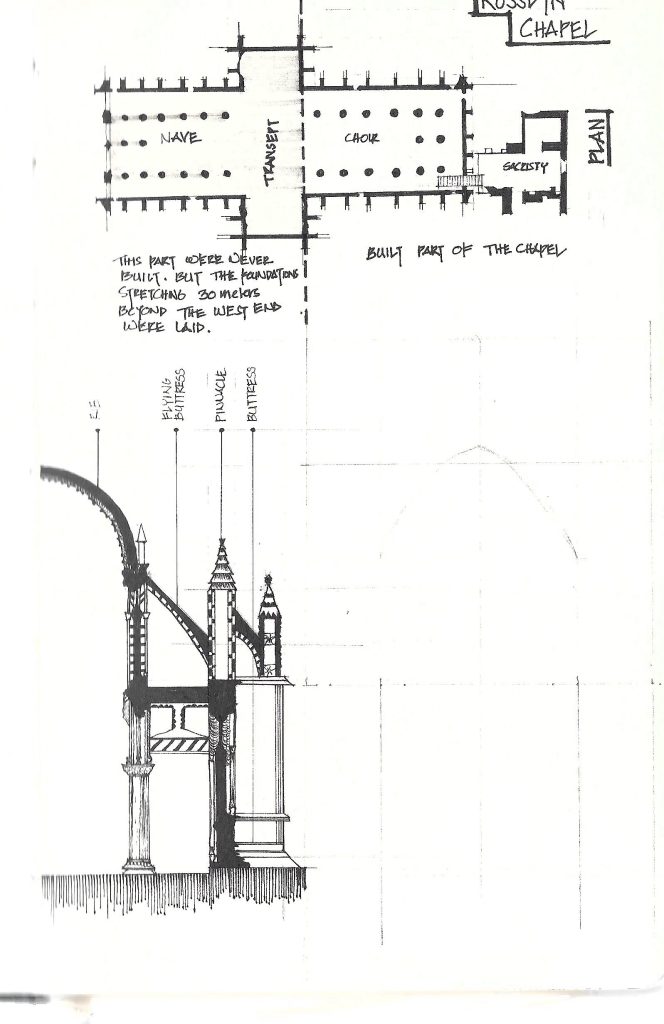
I visited Rosslyn Chapel in the summer of 2021. At that time, I was a third-year PhD candidate at the University of Edinburgh. I took a bus travelling south from Edinburgh to see this beautifully crafted and detailed medieval chapel. I spent a couple of hours in the chapel, learning about it like an architect. The chapel was supposed to be built in a cruciform layout; however, it was never completed and remains rectangular, with a sacristy at the basement level.
Wikipedia provides accurate historical and architectural information for general reference. Even the book I read on the chapel, entitled Rosslyn Chapel: An Icon Through the Ages by Angelo Maggi, examines this religious building as one of the most powerful and iconic cultural buildings in Scotland.
I am not here to talk about its history, architecture, or literature. I am here to talk about this chapel as a threshold. A ‘being’ holding memory and identity.
Situated in Roslin village, this Late Gothic chapel not only tells a mere story of pointed arches, ribbed vaulting, clustered columns, tracery, richly carved stone surfaces, or extensively dense symbolic ornament, but also narrates itself as a ‘being’ surviving abandonment after the Scottish Reformation in 1560 and as a ‘being’ celebrated by people after being visited by one of the finest queens Britain ever had—Victoria.
When discussing Rosslyn Chapel, it is important to talk about the magnificent ‘Apprentice Pillar’. My curious mind brought me to that chapel because of the story of this pillar. Among the 14 interior pillars of Rosslyn Chapel, 13 pillars are similar in design—simple, straight, and with stern geometric patterns designed by the master mason.
The story goes like this: one day, the master mason went away, giving his apprentices the job of completing the construction of the pillar. Upon returning, he found that one of his apprentices had built a pillar that was not his design. It was the apprentice’s own design—the serpentine floral details with dragon carvings at the base of the pillar. The master mason thought the pillar was extremely beautiful and killed the apprentice on the spot. How gruesome! What a sheer story of jealousy and negligence!
A master who is teaching his apprentices to work—this man could not bear that someone could dream up his own designs and apply them. Humans have surprised me over and over again. Why couldn’t the master mason simply accept that the apprentice’s mind could be different from his? Was death a verdict for such a creation?
Even Viollet-le-Duc described a comparable spiral pillar as gros boudins en spirale. Why cannot it be a ribbon spiraling through the structure? Why cannot it be the dragon’s tails carving their way out from the base?*
Why does criticism have to be as harsh as the master mason?
I just want to argue that the apprentice should not face a cruel death because he wanted to create something different. It should not be called ‘sausages’ simply because we need to criticise everything with mockery.
Our perspective can be multidimensional—good, bad, maybe. However, we must be cautious if we are really harming somebody just because someone wants to take a path different from ours and someone wants to create something that is not in our language.
Rosslyn Chapel survived abandonment and became celebrated, and its interior pillar survived the bloodshed of its creator. Centuries later, it remains an eminent structure, and will remain eminent.
*Viollet-le-Duc never specifically mentioned the Apprentice Pillar as spiral sausages. I believe he would call the spiral volutes of Salim Chishti’s tomb sausages too.

